

I.M. a Resident/Fellow: Emily Hagen, MD
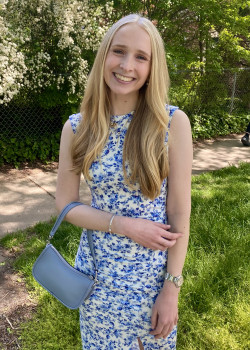
Emily Hagen, MD
Internal Medicine Residency
UMass Chan Medical School
Worcester, MA
In which residency or fellowship program are you currently in?
I am currently a third-year internal medicine resident at UMass Chan Medical School in Worcester, Massachusetts.
Why did you choose internal medicine? If you’re in fellowship, why did you choose that subspecialty?
I chose internal medicine because it brings together so much of what I love about medicine: diagnostic reasoning, problem solving, interdisciplinary teamwork, and, most importantly, the meaningful connections we form with patients. I knew that in internal medicine, I would have the privilege of caring for patients during some of the most difficult and vulnerable times in their lives, and this appealed to me greatly.
What lesson(s) did you learn in residency or fellowship that will help you for the rest of your career?
As internal medicine physicians, we often want to fix our patients. We spend years studying the science of medicine and learning how medications, procedures, and clinical decisions can improve health. But medicine is complicated. A medication that helps one organ system may worsen another. A procedure intended to solve one problem may create a new one. Social, emotional, and spiritual factors can further shape a patient’s experience of illness.
Throughout residency, I have learned that despite the many scientific advances in medicine, cure is not always possible. While I recognized this as a medical student, residency has helped me appreciate it more deeply. Sometimes the most important thing we can do is shift our focus from fixing to healing and truly serving our patients.
One of my favorite physicians, Dr. Rachel Naomi Remen, captures this beautifully: “Helping, fixing, and serving represent three different ways of seeing life … When you serve, you see life as whole.” This lesson will stay with me throughout my career.
What are your plans for after residency or fellowship? What factors or advice from mentors contributed to your decision?
After residency, I hope to pursue fellowship in hospice and palliative medicine. My experiences in the field to date have been deeply meaningful. To me, hospice and palliative medicine is one of the most patient-centered and humanistic specialties. I am drawn to its focus on supporting patients and families through serious illness, helping them navigate uncertainty, and honoring what matters most to them.
How has being a member of ACP helped you in your professional life? What resources have been most helpful to you?
As a medical student, I attended the ACP annual conference and found several sessions on applying to internal medicine residency very helpful. That experience showed me that ACP could be a valuable resource at different stages of my career.
More recently, ACP’s educational resources, including MKSAP and Annals of Internal Medicine, have been especially helpful during residency. MKSAP has been instrumental for board preparation and is also a useful reference on the wards.