

Internal Medicine and Family Medicine: Differences and Similarities
Although similar in many ways, differences in patient focus and training help define internal medicine and family medicine.
History
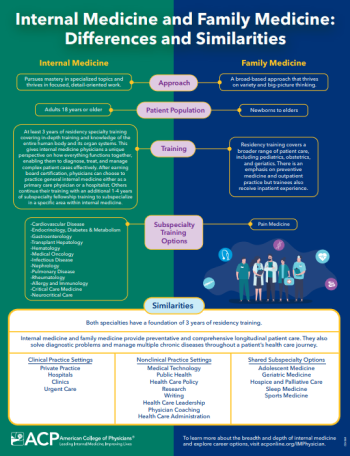
and family medicine training with this infographic.
In the late 1800s, internal medicine grew out of an increasingly “scientific” approach to medicine, which was applied to the wide spectrum of diseases that commonly affected adults. With the growth and development of pediatrics as a separate specialty in the early 1900s, internal medicine continued to focus primarily on adult patients.
Family medicine emerged from the general practitioner movement in the late 1960s in response to the growing level of medical specialization, which some believed threatened the doctor–patient relationship and continuity of care.
Patient Populations
Conceptually, family medicine is built around a social unit (the family) as opposed to a specific patient population, an organ system, or the nature of an intervention (e.g., surgery). Although internal medicine physicians focus on adult patients (18 years and older), many patients seen by family physicians are also adults. Additionally, an increasing number of family physicians do not include obstetrics, neonatology, or significant surgery as part of their practices, which makes the care they provide to adults appear like that provided by internal medicine physicians.
Training and Clinical Approach
There are significant differences in the training and clinical approach of internal medicine physicians and family physicians. Although the length of basic training for both is 3 years, internal medicine not only focuses on common general medical conditions but also includes significant experience in each of the internal medicine subspecialties. Trainees must also gain experience in psychiatry, dermatology, ophthalmology, office gynecology, otorhinolaryngology, nonoperative orthopedics, palliative medicine, sleep medicine, geriatrics, and rehabilitation medicine to care for adult patients comprehensively.
Internal medicine training takes place in both outpatient and inpatient settings. Trainees are required to have longitudinal, outpatient, continuity clinic experience and to see outpatients during their subspecialty clinical rotations. Trainees with experience in intensive/critical care settings also care for hospitalized patients. Most training programs require more than 1 year of hospital-based work with additional training on inpatient subspecialty services such as cardiology, hematology–oncology, or gastroenterology.
Family medicine training is typically based in dedicated outpatient training centers where residents work throughout their training. Trainees are required to provide acute, chronic, and wellness care for a panel of continuity patients, with a minimum number of encounters with children and older adults. Family medicine trainees also have several months of inpatient hospital experience, including adult critical care and care for children in emergency settings. Additional requirements can include obstetrics, newborn encounters, gynecology, surgery, geriatric care, and training in musculoskeletal medicine.
Family medicine trainees must also have experience in behavioral health issues, common skin diseases, population health, and health system management with a particular emphasis on wellness and disease prevention.
Skill Sets
The training differences between internal medicine and family medicine result in unique skill sets and unique strengths in patient care. Because internal medicine education focuses on adults and includes experience in both general medicine and internal medicine subspecialties, training in adult medical issues is comprehensive and deep. It allows internal medicine physicians to diagnose a variety of diseases that commonly affect adults and manage complex medical situations where multiple conditions affect a single individual. Internal medicine physicians are well prepared to provide primary care to adults through their outpatient continuity experience during training, particularly for medically complicated patients. Their training also enables them to interact with their internal medicine subspecialty colleagues effectively in co-managing complex patients (such as those with transplants, cancer, or autoimmune disease) and easily managing the transitions from outpatient to inpatient settings (and vice versa) for their patients who require hospitalization. Additionally, the extensive hospital experience during training uniquely prepares internal medicine physicians who choose to focus their clinical work in inpatient settings.
Family medicine education is broader than internal medicine because it involves training in the care of children and in procedures and services often provided by other specialties. This breadth of education equips family physicians to manage a wide range of medical issues and is particularly valuable in communities or geographical areas where certain specialists and subspecialists may not be available. Because of their broad skill set, family physicians typically adapt their practices to meet the specific medical needs of their communities. Although the depth of training in adult medical issues may be less than in internal medicine, the emphasis on outpatient medicine, continuity of care, health maintenance, and disease prevention allows family physicians to function as primary care physicians for adults as part of a family unit, depending on individual medical needs. Similar to internal medicine physicians, family physicians are trained to coordinate care among different specialists and subspecialists when needed.
For more information on program requirements, visit the Accreditation Council for Graduate Medical Education.
Learn more about the unique leadership roles, career pathways and impact of internal medicine physicians. Learn more