

Peer Perspectives: David D. Chen, MD, MPH
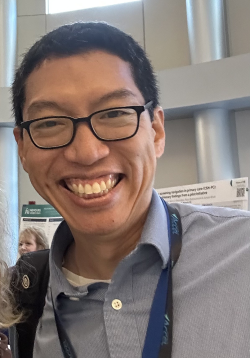
Hospitalist
ChristianaCare Health System
Wilmington and Newark, DE
Clinical Assistant Professor
Thomas Jefferson University Hospital-Sidney Kimmel Medical College
Philadelphia, PA
Medical Director
Empowering Victims of Lived Violence (EVOLV)
Wilmington, DE
Physician Scientist
Institute for Research on Equity and Community Health (iREACH)
Wilmington, DE
1. What is your current professional position?
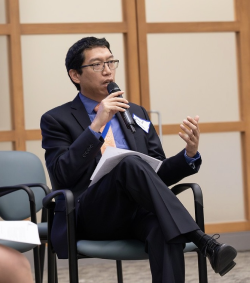
At ChristianaCare Health System, half of my time is as a hospitalist, seeing patients and teaching at our Wilmington and Newark, DE, campuses in a diverse set of roles. As a clinical assistant professor through Thomas Jefferson University Hospital–Sidney Kimmel Medical College, I teach residents and students on service, collaborating with the trauma service as a trauma hospitalist and taking care of patients with childhood-onset chronic conditions (COCCs) on our med–peds service. The other half of my time is as a physician–scientist, studying the impacts of violence on health and working as the founder and Medical Director for our hospital violence intervention program.
2. Why did you choose internal medicine?
I love how every question we ask reveals something new about both the diagnosis and the person. Through curious and compassionate inquiry into a patient’s life, we learn how to care for them better and add to our understanding of who they are. While this is true in any of the medical professions, as generalists we have access to understand all parts of the whole person.
3. What trends are you seeing in your day-to-day practice (with patients, the health care system, or otherwise)?
Nothing is more critical or fragile than a patient’s trust. Yet in today’s increasingly complex and convoluted care systems, a patient is asked to transfer and distribute that trust in innumerable ways: to partners in practice, administrative systems, electronic records and interfaces, medications and devices, and now even AI agents. Trust can only be diluted so much before an error, a comment, or a wayward click becomes the precipitating factor in its dissolution. Such trust is extremely difficult to regain and might even seem permanently gone, but it can be achieved…if given warmth, time, and vigilance.
4. What do you want to accomplish professionally within the next five years?
I want to still be practicing and teaching medicine. In an early career already marked by burnout and chaos, I had difficulty imagining this same goal 5 years ago. Thanks to the insight from counseling, the reshaping of goals and expectations by coaches, and the support of colleagues and family, I look forward to this future.
5. Can you share a brief (and anonymous) patient encounter or professional situation that made you proud to be an internal medicine physician?
I helped a patient get a cheeseburger. She had been on noninvasive positive pressure ventilation with escalating multisystem organ failure, struggling to understand and decide on the implications of intubation. The days of progressive decline leading up to this penultimate decision were marked by a series of conversations about her illnesses, the benefits and limits of treatment, and the likely outcome of death. While speaking through that mask, she understood clearly what was going on, decided she wanted to die peacefully and transition to comfort-oriented care, and trusted me to keep taking care of her. So I asked her what meal she’d want when the mask came off. It was a cheeseburger.