

In the News
A Reminder of the Importance of Addressing Health Worker Burnout
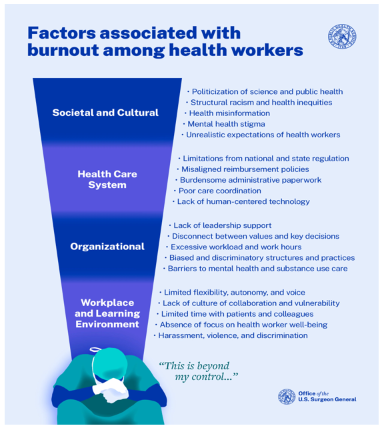
and Human Services. Use of this figure does not constitute endorsement
or recommendation by the U.S. Government, Department of Health and
Human Services.
We are resharing the 2022 Surgeon General's Advisory on physician burnout. This advisory contains steps that different stakeholders can take together to address health worker burnout. It calls for change in the systems, structures, and cultures that shape health care. The realities of our health care system are driving many health workers to burnout. They are at an increased risk for mental health challenges and choosing to leave the health workforce early. They work in distressing environments that strain their physical, emotional, and psychological well-being. This will make it harder for patients to get care when they need it.
Preventing Physician Suicide: Identify and Support At-Risk Physicians
AMA Ed Hub
This toolkit will help you identify risk factors and warning signs for suicide among physicians. It outlines how to build an environment of support into your practice and make it easy to get help.
Occupational distress factors associated with suicidal ideation among physicians and comparison with other US workers
Academic Medicine: A. Fischer, T.D. Shanafelt, L.N. Dyrbye, C.P. West, C.A. Sinsky, M. Tutty, H. Wang, L.E. Carlasare, M.T. Trockel
This study evaluates associations with suicidal ideation (SI) of impact of work on personal relationships, self-valuation, and imposter phenomenon and compares the SI point prevalence in physicians versus other workers.
Duty to Reduce Uncontrollable Stress in Healthcare Workers. Help Is on the Way
Health: M.R. Privitera, E. Slutsky, J.R. Ciccone, T. Chan, X. Hu, E.L.B. Greene, C. Cerulli
Current healthcare worker (HCW) work environments are characterized by uncontrollable stress manifested by little ability to escape from or influence mitigation of that stress. Leaders of healthcare work environments are in the prime position to reduce the factors that create uncontrollable stress conditions, thereby enabling HCWs psychological safety for feedback, opportunity to influence their work environment, express ideas for improvement, as well as allowing more options for choice in fulfilling their duties.
Recent Research, Practical Takeaways: When the Screening Question Isn't Enough
Johns Hopkins Center for Suicide Prevention
Most suicide risk screening begins with a question: have you had thoughts of killing yourself? It is a reasonable place to start. It also assumes the person will say yes. This research study asks among people already carrying a heavy symptom burden, what distinguishes those who endorse suicidal ideation from those who do not?
Back to the September 18, 2026 issue of ACP IM Thriving