Subspecialist
Subspecialists in internal medicine have chosen to receive additional, more in-depth training and board certification in the diagnosis and management of diseases of a specific type (e.g., infectious diseases) or diseases affecting a single organ system (e.g., the heart). Although subspecialists often see patients for a limited basis in consultation from a general internist or another medical specialist, they too may develop long and rewarding relationships with patients who have ongoing or chronic illnesses that demand continued care.
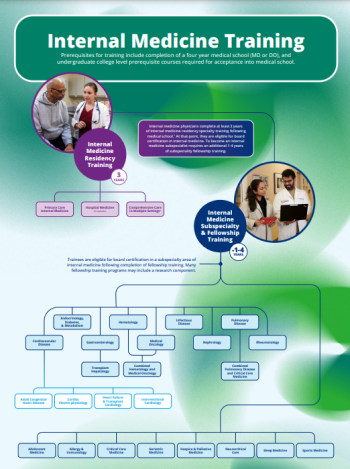
Once general internal medicine residency training is complete, a physician may begin to practice internal medicine. Alternatively, many physicians wish to obtain further subspecialty training in a more limited area with a plan to focus their future activities on diseases of one type or organ system. Subspecialty training, called fellowship, usually adds two to three years after medical residency. Applications for fellowship are generally submitted during the second year of the internal medicine residency.
Cardiovascular Disease/Cardiology
Cardiology is the prevention, diagnosis, and management of disorders of the cardiovascular system, including ischemic heart disease, cardiac dysrhythmias, cardiomyopathies, valvular heart disease, pericarditis and myocarditis, endocarditis, congenital heart disease in adults, hypertension, and disorders of the veins, arteries, and pulmonary circulation.Clinical Cardiac Electrophysiology
Clinical Cardiac Electrophysiology is a branch of Cardiology that manages complex cardiac arrhythmias with the use of implantable pacemakers and cardioverter-defibrillators, and also applies other interventional techniques and treatments.Critical Care Medicine
Critical care medicine encompasses the diagnosis and treatment of a wide variety of clinical problems representing the extreme of human disease. Critically ill patients require intensive care by a coordinated team. The critical care specialist (intensivist) may be the primary provider of care or a consultant. The intensivist needs to be competent not only in a broad range of conditions common among critically ill patients but also with the technological procedures and devices used in the intensive care setting.Endocrinology, Diabetes and Metabolism
Endocrinology is the diagnosis and care of disorders of the endocrine system. The principle endocrine problems include goiter, thyroid nodules, thyroid dysfunction, diabetes mellitus, hyper- and hypocalcemia, adrenal cortex dysfunction, endocrine hypertension, gonadal disorders, disorders of sodium and water balance, manifestations of pituitary disorders, disorders of bone metabolism, and hyperlipidemia.Gastroenterology
Gastroenterology encompasses the evaluation and treatment of patients with disorders of the gastrointestinal tract, pancreas, biliary tract, and liver. It includes disorders of organs within the abdominal cavity and requires knowledge of the manifestations of gastrointestinal disorders in other organ systems, including the skin. Additional content areas include nutrition and nutritional deficiencies, and screening and prevention, particularly for colorectal cancer.General Internal Medicine
Internal medicine is a specialty that relies on the basic sciences and a diverse breadth of knowledge to form the foundation for a successful career in a variety of fields, including general internal medicine, hospital medicine, or any of the internal medicine subspecialties. Specialists in general internal medicine (“general internists”) are crucial in filling a vital need in our health care system, serving as the primary or principal providers of care in outpatient (ambulatory) and /or inpatient (hospital) settings.Geriatric Medicine
Geriatric medicine involves the recognition of differences in presentation of disease and the importance of maintaining functional independence in elderly patients. Geriatrics is a primary care discipline oriented toward preventive, routine, acute, and chronic medical care of elderly patients.Hematology
The discipline of hematology relates to the care of patients with disorders of the blood, bone marrow, and lymphatic systems, including the anemias, hematological malignancies and other clonal processes, and congenital and acquired disorders of hemostasis, coagulation, and thrombosis.Infectious Disease
Infectious disease medicine requires an understanding of the microbiology, prevention, and management of disorders caused by viral, bacterial, fungal, and parasitic infections. This understanding includes the appropriate use of antimicrobial agents, vaccines, and other immunobiological agents. Important content includes the environmental, occupational, and host factors that predispose to infection, as well as the basic principles of epidemiology and transmission of infection.Interventional Cardiology
Interventional Cardiology is the branch of Cardiology responsible for catheter-based interventions in the management of ischemic heart disease, congenital heart disease, and acquired valvular disease.Medical Oncology
Medical oncology is the subspecialty which involves the diagnosis and management of benign and malignant neoplasms. Oncologists typically identify individuals at risk for malignancy and counsel them regarding risk reduction and screening, investigate clinical symptoms and syndromes suggestive of underlying malignancy, identify and treat neoplasms with a potential for cure, and undertake the care of patients with solid and hematologic tumors to prolong life and/or palliate symptoms.Nephrology
Nephrology involves the diagnosis and management of diseases of the kidneys, the contiguous collecting system, and the associated vasculature.Pulmonary Disease
Pulmonary medicine is the diagnosis and management of disorders of the lungs, upper airways, thoracic cavity, and chest wall. The pulmonary specialist has expertise in neoplastic, inflammatory, and infectious disorders of the lung parenchyma, pleura and airways; pulmonary vascular disease and its effect on the cardiovascular system; and detection and prevention of occupational and environmental causes of lung disease. Other specialized areas include respiratory failure and sleep-disordered breathing.Rheumatology
Rheumatology deals with the prevention, diagnosis, and management of crystalline diseases, systemic rheumatic diseases, spondyloarthropathies, vasculitis, inflammatory muscle disease, osteoporosis, osteoarthritis, recreational sports injury, soft-tissue diseases and trauma. The goal of the rheumatologist is the early diagnosis and treatment of these conditions to prevent disability and death.Sleep Medicine
Physicians who specialize in Sleep Medicine are trained to detect, treat, and prevent sleep disorders, such as obstructive sleep apnea, snoring, insomnia, sleep walking, and jet lag.Transplant Hepatology
Transplant Hepatology training involves one year of additional clinical training after completion of both residency in internal medicine and fellowship training in gastroenterology. Candidates must also complete the following procedural requirements: performance of at least 30 percutaneous liver biopsies, including allograft biopsies; interpretation of 200 native and allograft liver biopsies; and knowledge of indications, contraindications, and complications of allograft biopsies.
Adolescent Medicine
Adolescent medicine focuses on the physical, psychological, social, and sexual development of adolescents and young adults. Multidisciplinary and comprehensive in approach, this specialty encompasses the full spectrum of acute, chronic, and preventive health care.Allergy and Immunology
Allergy and immunology involves the management of disorders related to hypersensitivity or altered reactivity caused by the release of immunologic mediators or by activation of inflammatory mechanisms.Hospice and Palliative Medicine
Palliative medicine aims to relieve symptoms and pain a patient suffers due to a serious illness. Goals of palliative care include reducing suffering, improving the quality of life for a patient, and supporting the patient and family throughout the treatment process.Hospice care is provided for patients facing a terminal diagnosis who no longer wish to undergo curative treatment. Goals of hospice care include relieving symptoms and supporting patients in the end-of-life stages.
Sports Medicine
The discipline of sports medicine primarily concerns itself with the emergency assessment and care of acutely injured athletes, diagnosis, treatment and management of common sports injuries and illnesses, management of medical problems of the athlete, rehabilitation of ill and injured athletes, and exercise as treatment.
Combined Internal Medicine and Pediatrics
Combined Internal Medicine and Pediatrics (Med-Peds) is the dual training in and dual practice of Internal Medicine and Pediatrics. Physicians practicing Med-Peds see both adults and children in a wide variety of practice settings and practice styles. Practice settings range from outpatient primary care to inpatient hospitalist practice, and practice styles range from urgent acute illness care to the longitudinal chronic illness care of patients with congenital heart disease.